
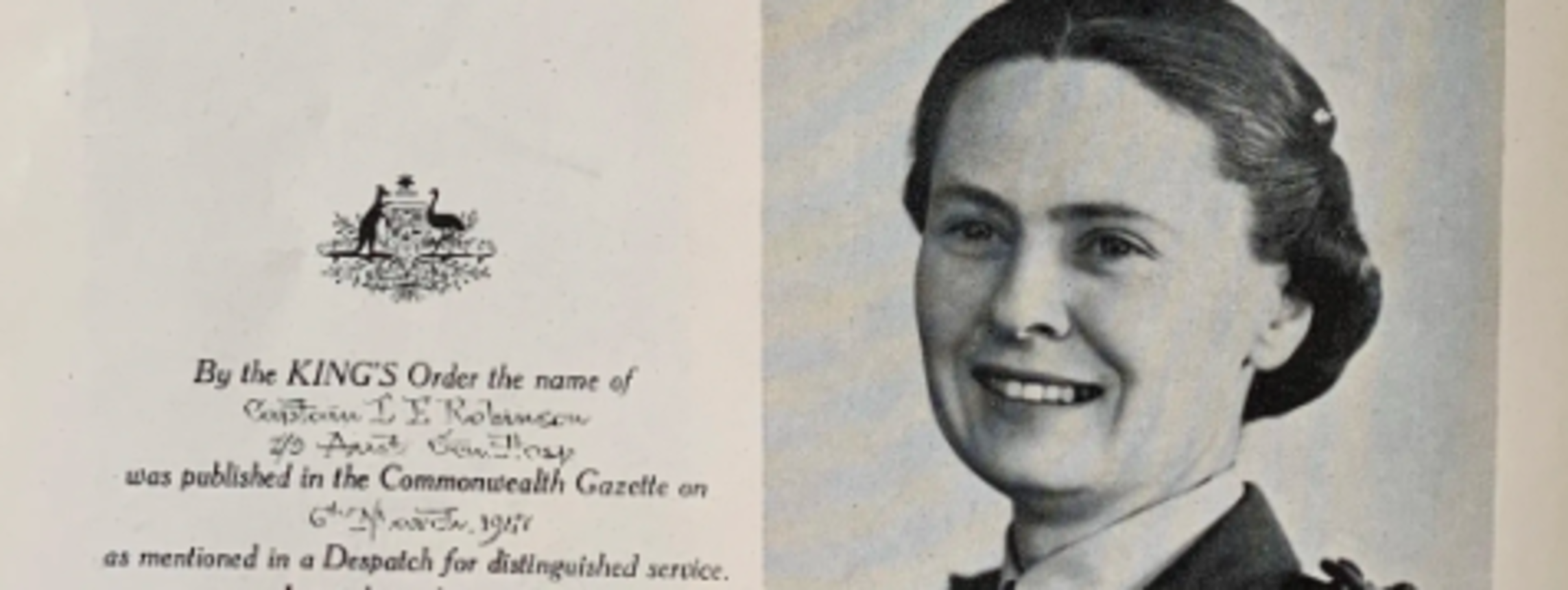
Profile - Captain Lydia Elizabeth Robinson (1930)
Lydia Elizabeth Robinson was born on 7 February 1910 at Herberton, in Queensland's Atherton Tablelands. Her father, Frederick William passed away on 19 November 1919 at Wooroora Station, Woolooga, Queensland when Lydia was 9 years old.
Lydia, her sister, Kathleen and her mother, Christina later relocated to 238 Boundary Street, West End, and Lydia was enrolled at Somerville House in 1921. It is unclear how long Lydia stayed at Somerville House, but it is known that she was a member of the Class of 1930. In the 1937 Electrol Roll, Lydia was living at West End with her mother and sister, and each of their occupations was listed a 'home duties'.

On 6 March 1942 at age 32 years and 11 months Lydia enlisted in the Voluntary Aid Detachment (VAD) at Brisbane and was stationed at Kangaroo Point and then at the newly opened 112th Australian General Hospital, which was the forebear of the current Greenslopes Private Hospital.
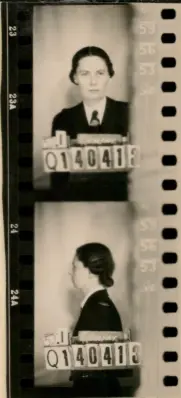
On 9 January 1943, while holding the rank of Acting Sergeant, Lydia enlisted in the Australian Army Medical Women's Service (AAMWS) with whom she served until 8 May 1946. The AAMWS had been formed in December 1942 and its members served as nurses in military hospitals in Australia, Papua New Guines and the Middle East during World War II. The AAMWS was established to distinguish between full-time military Voluntary Aids who were serving at Military Hospitals on a full-time basis under Army control (the AAMWS) and those attached on a voluntary basis to the aid organisations (the VAD).
Whilst serving in the AAMWS, Lydia was promoted to Lieutenant on 16 April 1942. In September 1944 she applied to transfer to the 2/7 Australian General Hospital which had been established in Lae, Papua New Guinea in May 1944 but does not appear to have been sent. On 23 December 1944 Lydia was promoted to Captain attached to the AAMWS command at the 2/9 Australian General Hospital, which was located on the small island of Morotai.
Lydia served in the AAMWS for a total of 1,525 days, 1,1182 of which were in Australia and 304 days overseas from 18 May 1945. During World War II, Morotai belonged to the Netherlands East Indies (NEI, now Indonesia). The Battle of Morotai, part of the Pacific War, began on 15 September 1944, and continued until the end of the war in August 1945. The fighting started when United States and Australian forces landed on the southwest corner of Morotai, which the Allies needed as a base to support the liberation of the Phillipines later that year.
On Saturday 7 July 1945 in the 'Social Sidelights and Personalities' section of the Telegraph newspaper in Brisbane published an article about Lydia's arrival in Morotai -
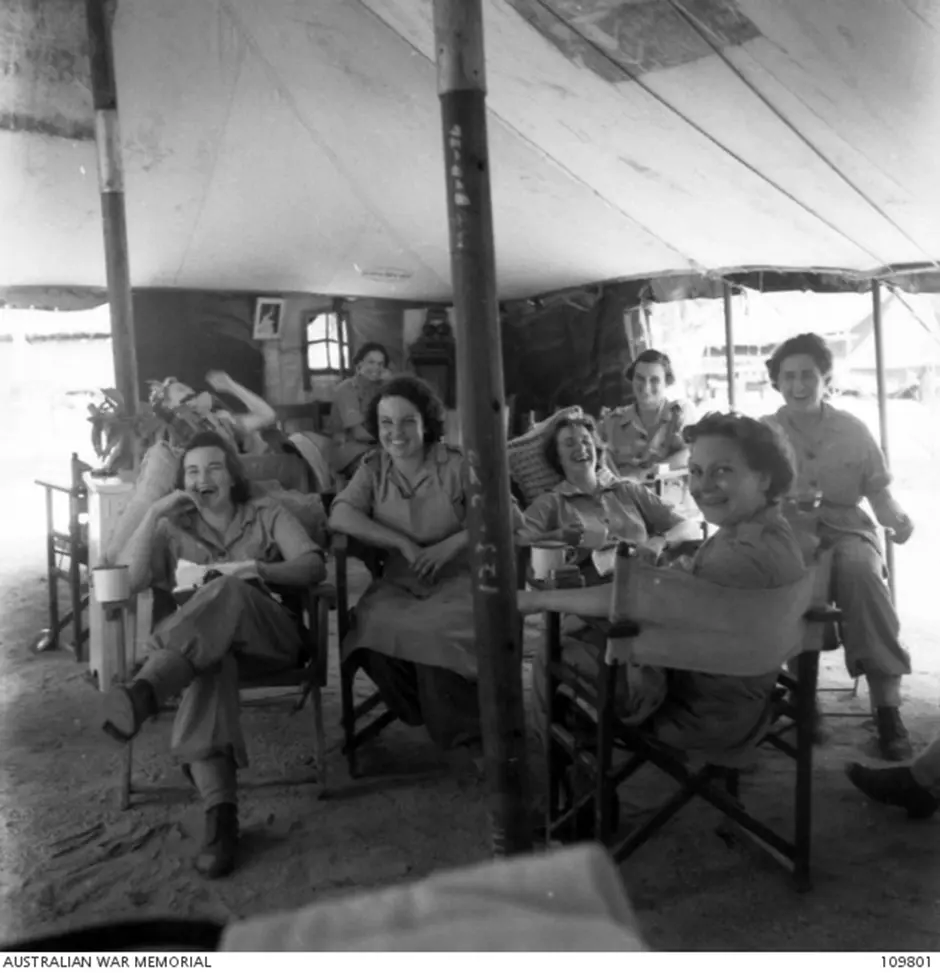
'"THE CO and several of the officers were at the wharf to meet us and put the excited girls into the buses which were to take us to our home," writes Captain Lydia Robinson, of Brisbane, who is in charge of a group of AAMWS at a forward area.
We had a lovely drive through a coconut plantation," she continues. "The sisters' and AAMWS lines are at the far end of the hospital and the tents are situated in a coconut plantation. The soil is very good, so it should not be long before we have plenty of flowers and vegetables. "We had next day to settle in, so we really were very lucky to get all our washing done before starting work in earnest. "The men of the unit have been marvellous to us. Our tents were up and all our luggage in before we arrived. All I did was to give the girls a tent list while we were waiting in the ship. "The men had made a combined dressing table and wardrobe for matron and myself. "Food is very good and there is no excuse for anyone to be sent back to Australia because of lack of vitamins. Each day for the midday meal we have as much pure fruit or tomato juice as we want. All food is well cooked and tastefully served, even if a lot of it comes out of a tin. "I have a very nice office (tent) on one side of the main road which, with its constant traffic, is most interesting. On the other I look across the hospital area, with wards dotted among the palm trees to the harbour. Queensland girls from the other unit had a supper party for the Queensland girls in my unit and we had quite a lot to chat about."
The 2/9 Australian General Hospital, a 1,000-bed hospital, was built to support the approximately 60,000 air force and army personnel who were based on Morotai.They provided surgical teams for landings and helped rehabilitate prisoners of war. Lydia was one of the Hospital's final staff who returned to Australia on March 2, 1946.
Shortly prior to Lydia's arrival in Morotai, the US 93rd Infantry Division had been deployed to Morotai during April 1945 to replace the 31st Division. The 93rd Division was a segregated African American unit and was mainly used for security and labor tasks during the war.The 93rd Division also undertook combat operations and operated logistics facilities. The division's commander tasked his combat units with destroying the remaining Japanese force on Morotai, which was estimated to comprise between 500 and 600 men. One of the division's main goals was to capture Colonel Ouchi and this was achieved by a patrol on 2 August. Ouchi was one of the highest-ranked Japanese officers to be captured before the end of the war in mid-August 1945.
Lydia was living in the centre of the world's focus in August and September 1945 when Morotai was the scene of a number of surrender ceremonies following the surrender of Japan.The facilities on Morotai continued to be heavily used by the Allies in the months after the war. The Australian force responsible for the occupation and military administration of the eastern NEI was headquartered at Morotai until April 1946, when the Dutch colonial government was reestablished.
On Saturday 17 November 1945 the Telegraph's 'Social Sidelights and Personalities' column published another update from Lydia -
"When a member of the AAMWS stationed at 2/9 AGH in Morotai was married recently both she and her bridesmaid wore frocks made by fellow members from material used for plastic bandages.
Captain Lydia Robinson, who is in charge of the AAMWS in that area, when writing to Major M. Roche, said that the bride looked lovely in her long white frock fashioned with a full skirt, tight bodice and heart-shaped neckline. The veil, which had been sent from Australia, was held together by real flowers. The bridesmaid, whose frock was made on similar lines to that of the bride, carried a Victoria posy of flowers plucked from the AAMWS garden plot. The girls rallied round the bride and gave or lent all the bits and pieces a bride must have. All patients who could walk, and members of the staff turned out to see the first bride dressed in full array step out of the car to enter the chapel. The natives had been busy the day before decorating the chapel and the recreation hut with yellow tipped split- palm leaves which made a lovely setting. The day commenced with a nuptial Mass, which was followed by a cup of tea. The bridal party then set off on a 20 mile drive to Nica. where the marriage was celebrated according to Dutch law, which Is the only ceremony recognised in those parts."
On 8 May 1946 Lydia was discharged from the AAMWS at Brisbane. A year later her War Record was noted her as having been 'Mentioned in Despatches' on 6 March 1947.
One of the oldest Imperial forms of recognition for bravery or distinguished service is when a serviceman or servicewoman was Mentioned in Despatches. A despatch is an official report, written by a senior commander in the field to pass on information about the progress of military operations. Commanders would include in their despatches the names of those deserving attention to their services. Following World War II, an emblem of a single bronze oak leaf was issued to individuals who had been Mentioned in Despatches, which was worn in the centre of the 1939–1945 War Medal.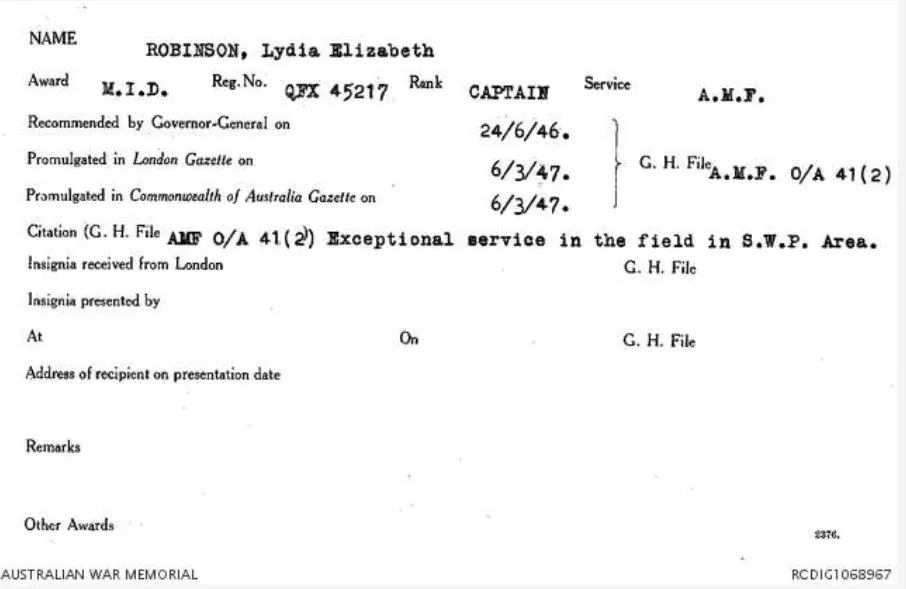

Following the War, Lydia returned home to 238 Boundary Street, West End where she lived until the early 1970s. By 1977 her mother had passed, and Lydia had likely moved to a more modern unit at 7/161 Moray Street, New Farm, where her occupation continued to be listed on the Electoral Roll as home duties. She did not marry, and passed away at the age of 87 years on 28 March 1997.
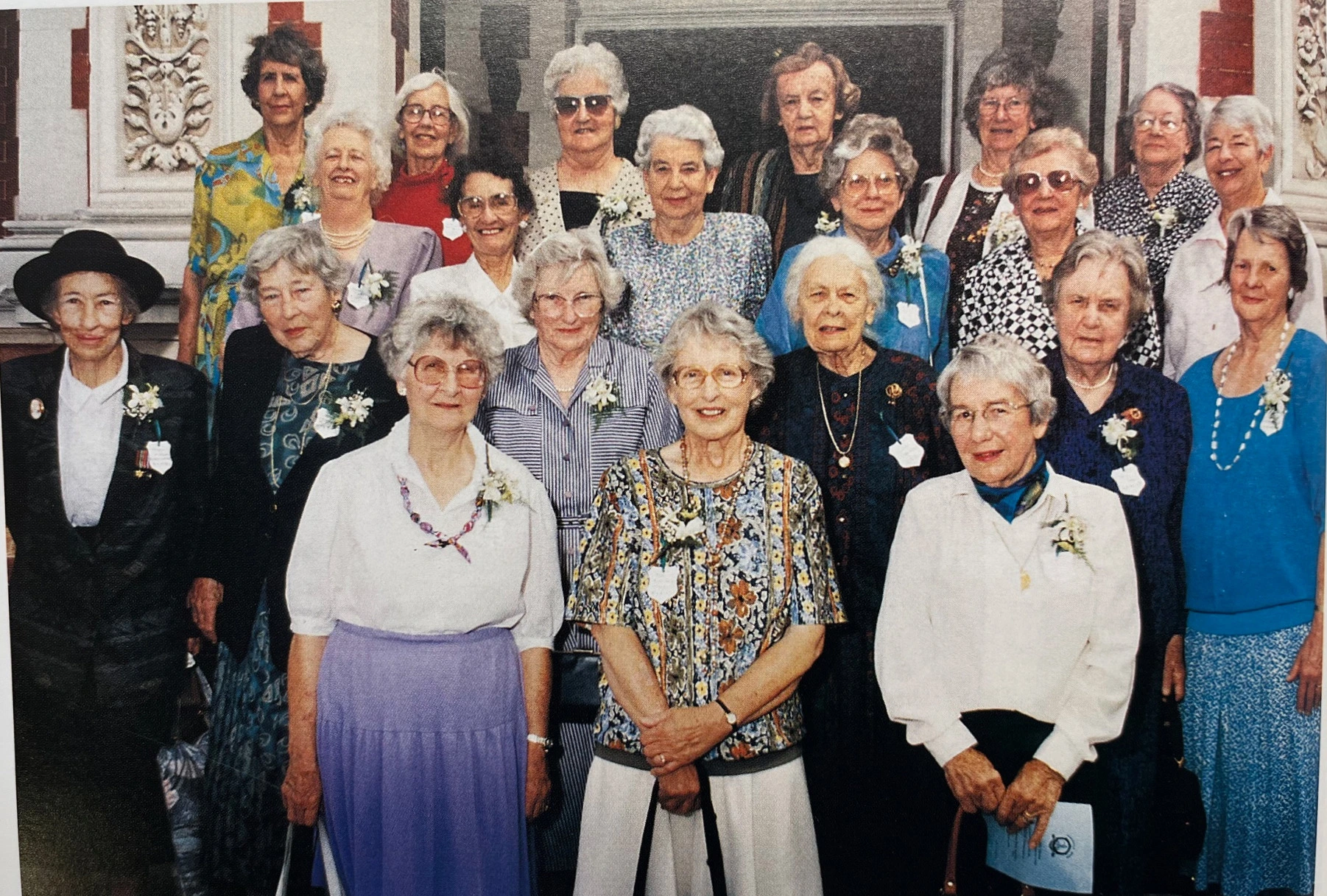
She is pictured (second row, third from the right) in this photograph taken on 6 October 1995 at Somerville House's 'Somerville Remembers' Commemoration Day service to mark the 50th anniversary of the end of the War in the Pacific on 15 August 1945.
Credit - www.trove.com.au for the Telegraph articles.